Best Time for the Manaslu Expedition
The best time for the Manaslu Expedition is the pre-monsoon and post-monsoon period. It has the most favorable weather conditions for climbing. These two most favorable seasons are from late March to May and September to November, respectively. During these months, the weather is more stable, and relatively mild temperatures indicate fewer risks for climbers.
The pre-monsoon is a bit warm with a clear blue sky. There are fewer chances of snowfall. The days are long, so you will have better daylight hours to climb. This is the most popular season since conditions can be much more predictable in general. Thus, it allows for much better planning.
This post-monsoon season is also good for the expedition. The weather is pretty clear and crisp, and there is a lower chance of heavy snowfall. Likewise, temperatures are cooler than in spring but still manageable. This season tends to be less crowded compared with the pre-monsoon season.
It is most important to avoid it from June to August, the monsoon season. During this time, heavy rainfall makes the weather unstable, and the possibility of avalanches and landslides is quite high. Manaslu generally remains inaccessible because of poor weather conditions.
When is the Right Time To Start?
The best time for the Manaslu Expedition is in the Spring season (April to May) and Autumn season (September to October). These months are usually more stable than the rest of the year. It provides a relatively safer and more comfortable journey. In 2025, we have fixed departures on April 3 for springtime. September 1 and September 21st for the autumn season.
Each trip covers 38 days of travel time, which gives enough time for walking for 35 days. So, you also have enough time for acclimatization to rest and get used to the high altitude. The earlier you start the journey of trekking, the easier it gets to help avoid possible circumstances. Since the weather is usually clearer and the temperature is somewhat survivable. Spring is undoubtedly a season for blooming landscapes and longer days, but the mountain scenery in autumn is very impressive, with crystal clear skies. You can plan an adventure in advance to ensure the best weather and make the most of your journey.
Why Choose the Manaslu Expedition?
The Manaslu Expedition is a unique adventure that offers a thrilling challenge along with stunning views and rich cultural experiences. It is a rewarding challenge with breathtaking scenery, cultural insight, and fewer crowds, making for an unforgettable experience for the climbers.
Firstly, Manaslu is the eighth-highest mountain in the world, standing at 8,163 meters. Climbing the summit is a remarkable achievement, especially if you’re looking for an 8,000m peak that’s not very crowded. This gives you a quieter and more focused experience on the mountain.
The second is that the route to Manaslu is less crowded than other popular climbs. That is to say, you will have more peaceful journeys, which enable you to fully submerge yourself in the adventure at hand, the trek to base camp right to the climb itself. You get to enjoy the beauty of the surroundings without the hustle and bustle of a very large group.
Thirdly, the route to Manaslu Base Camp passes through awesomely beautiful landscapes and villages, allowing you to explore some of Nepal’s most culturally unique sides. Throughout your journey, you will encounter amiable Gurung and Tibetan communities.
Last but not least, though difficult, it is climbable by experienced climbers. It’s far less technically challenging than other 8,000m peaks, which makes it perfect for those who intend to test their powers at great heights without excessive complication.
Weather and Climate Conditions on Manaslu
Manaslu has varied weather and climate, mostly due to the altitude differences you will face in this expedition. At lower altitudes of around 1,963 meters at Dharapani, temperatures maintain moderate ranges, fluctuating from 10°C to 20°C during the day. At night, temperatures could get cold, between 5 and 10°C. The higher you go, the colder it gets.
Of course, the higher the altitude, the colder it gets. This is taken to the extreme at Manaslu Base Camp, at 4,700 meters. During the day, temperatures can run between -5°C and 5°C while plummeting at night to as low as -10°C, -15°C, or even lower. Big snowfalls are quite normal during climbing in these high-altitude areas, which makes climbing more challenging.
Above the summit zone at a height of 8,163 meters, the temperature can drop as low as -20°C to -30°C and sometimes even more with wind factor. The weather is unpredictable and can storm at any moment, making conditions quite challenging for climbers.
This expedition involves bad weather, including high snow storms, winds, and very low temperatures while climbing. Good equipment and preparation are tantamount to handling such situations safely. Be prepared for probable weather changes, especially when approaching zones of high altitude on the mountain.
Challenges of the Manaslu Climb
A number of factors make the Manaslu Expedition both physically and technically challenging. The altitude factor. As one ascends upwards, the air that one breathes becomes thin. Hence, carrying less oxygen per unit volume means reduced breathing and heightened fatigue. It is necessary to ascend with patience and acclimate properly to avoid altitude sickness.
In addition to all of this, the technique involves incredible skill. You are using crampons on ice and snow. You must also know how to rappel safely, even with a pack on. You should also know and confidently use ascenders when climbing steep fixed ropes. This is especially true at higher altitudes. All these technical issues may be psychologically draining since every stage requires utmost focus and complete confidence in one’s skill.
It can also be bad weather that makes it difficult to climb. Added to high altitude, snowstorms, freezing temperatures, and strong winds make the climb even more miserable. The weather can be so unpredictable that you should always be prepared and flexible with whatever will come.
Another challenge deals with unpredicted delays. Harsh weather conditions or any other unforeseen factor might really lower progress. You need to be flexible enough to adapt to such situations and keep cool. The duration of the expedition itself maintains your energy and strength for an extended period, which is tedious.
After all these challenges, the Manaslu Expedition is rewarding. You will be capable of overcoming each obstacle with proper preparation. Experience a positive outlook and stand finally at the summit.
Camp Setup and Accommodation Options
Accommodation during the Manaslu Expedition varies with altitude. From basic at camps to technical at higher altitudes.
Base Camp is located at a height of 4,700 meters. It is comfortable and well-established with essential facilities. The place is fitted with large tents for eating, resting, and sleeping. Smaller personal tents are also available. Base camp is an active place where mountaineers, guides, and Sherpas all work in concert for a successful climb. There is a large communal tent where food is served, providing variety to keep you nourished for your energy needs. The emphasis here is on the preparation for the higher climbs.
Going upwards, you would be transferred to High Camp, which is usually established at an altitude of about 6,400 meters. The conditions in the high camp are very basic. Nevertheless, the tents will also be well-anchored in their places to resist strong winds and low temperatures. There are smaller sleeping tents and a separate cooking area, but very small in size. As a matter of fact, the facilities will be minimalistic; still, they will provide you with the minimum amenities required for rest and acclimatization in the final push toward the summit.
These camps represent the perfect balance of safety, comfort, and functionality so that one can focus on a climb without wanting anything.
Food and Nutrition During the Manaslu Expedition
One of the most important things during the Manaslu Expedition is keeping oneself duly filled with nutrients to develop or sustain energy and strength for the climb. The food offered on a trek usually includes simple yet nutritious meals. Dal bhat is common at lower altitudes, and it is a staple in Nepal, along with vegetable noodles and bread. The menu will get even simpler as you go up higher. Still, porridge, eggs, potatoes, pasta, and soup will be more common options. These meals are essential to keep your calorie intake up during long trekking days.
At altitude, one should focus on carbs for energy, proteins to keep strong muscles, and fats to sustain energy. Other snacks such as nuts, energy bars, and dried fruit can help keep you going between meals. Hydration is just as important. Be sure to drink plenty of water and hot drinks such as tea or soup.
Good advice is to eat small, frequent meals instead of heavy meals, as this would make one feel lethargic. Track your calorie intake and simultaneously keep your body well-hydrated to help your system work effectively during the strenuous days of the Manaslu climb.
Guided vs. Independent Climbing Options
Critical considerations for the choices between guided or independent climbing options regarding the Manaslu Expedition.
In itself, hiring a guide has major advantages. A guide provides local knowledge, experience, and expertise for safety, especially under challenging conditions. They handle permits, logistics, and route planning, freeing you to focus on the climb. If you are new to high-altitude expeditions, then a guide will definitely serve as a huge support system. The main drawback is the money required to pay for the services of a guide.
Independent climbing is relatively cheap. If you have experience with mountaineering and don’t mind being on your own, you’ll probably enjoy the independence and flexibility of climbing without a guide. You’ll be in control of your schedule and route, but this freedom entails greater responsibility. Knowing the local conditions and having the backup of a guiding company could be very dangerous, especially in an area like Manaslu, where conditions can be highly variable.
In other words, if you are an advanced climber with a reliable support team, independent climbing may be a good choice. For most people, the benefits of engaging the services of a guide in terms of safety, expertise, and convenience outweigh the costs.
Sherpa and Support Team Roles
The Sherpa and support team are invaluable assets to the success of the Manaslu Expedition. These experienced climbers and staff are immense help throughout the journey one has undertaken. Sherpas are renowned for their perfect knowledge of the mountain, including potentially difficult sections of the climb. They will help carry your gear, set up camps, and guide you safely through challenging sections. Their experience is of most importance, especially at high altitudes.
Others include the support team, which includes cooks, porters, and any other employee who ensures all goes well. The cooks prepare very nutritious meals that enable one to sustain energy in the climb. The porters carry heavy luggage, letting climbers focus on their ascend; with them, it was much more tiring and highly efficient.
Overall, the Sherpa and the support team are highly important in any safe and successful climb. Their commitment and expertise enable you to focus on your goal while they look after everything else that concerns logistics and safety.
Insurance Requirements for High-Altitude Climbing
Having the right kind of insurance is very important for your safety and peace of mind during this expedition. You actually need two kinds of main insurance coverage: one for trekking and another for high-altitude climbing.
First, trekking insurance covers you for general accidents, cancellations of a trip, medical emergencies, and emergency evacuations up to a certain altitude. Since Manaslu is a high-altitude climb, you will need to add on climbing-specific insurance accordingly. The additional coverage is for accidents at altitudes above 4,000 meters and includes things like medical evacuation, mountain rescue, and summit-related emergencies.
Furthermore, ensure that your insurance covers heli-evacuation in case of an emergency. A few insurance policies also cover gear loss or damage on expeditions. Always read the policy for altitude limits, as some do not cover climbs over 6,000 meters.
Before going on the expedition, make sure you provide a copy of your insurance to your guide or expedition team as an extra precaution and safety measure.
Cost Breakdown of the Manaslu Expedition
The cost of the Manaslu Expedition depends on a few factors. We can break this down further by showing the breakdown of the cost information in some detail to help in budgeting.
Permit Costs: Special permits are required for the Manaslu Trek. A permit for Manaslu would cost around $100 per person; if applied for, there may be additional costs for Tsum Valley. The Annapurna Conservation Area requires a timed entry permit, which costs around $30 USD.
Guide and Porter Fees: A certified guide is highly recommended not only for safety and navigation but also as a formality. Hiring a guide will cost around $25-30 USD per day, and hiring a porter will cost roughly $20 USD per day.
Climbing Permit: The Manaslu climbing permit cost alone is one of the priciest components of the cost, at $1,800 on Spring and $ 900 during Autumn.
Food and Accommodation: Regarding food and accommodation in teahouses along the way, one needs to budget around $40-60 USD daily.
Additionally, keep these costs to a minimum by booking early and selecting a reliable expedition company. Other expenses may include equipment, insurance, and transportation, which add up to $1,000-1,500 in United States dollars.
Physical Conditioning: Strength, Endurance, and Flexibility
The Manaslu Expedition requires extensive physical conditioning to be successful. Ideally, strength, endurance, and flexibility will be needed for the demanding climb. In strength training, squats, lunges, and leg presses will be instrumental in developing lower body power. Long-distance walking, hiking, or running would improve endurance.
Try carrying a pack while training to simulate real conditions. Add flexibility exercises like yoga to your training. This will help you become flexible, especially in the hip and hamstring areas. Other important things are training at higher altitudes to build stamina and oxygen tolerance. Combining all of these regularly will get you physically prepared.
Essential Clothing and Gear for Manaslu
Correct clothes and equipment will be vital for the Manaslu Expedition, from base layers that wick moisture from your skin to insulating layers like fleece or down jackets that keep your body warm.
You will also need a waterproof, windproof layer, including a shell jacket and pants, to protect you against the elements. Again, remember to bring along warm gloves, hats, and neck gaiters for cold weather protection. For sleeping at base camp and higher altitudes, a -20°C (-4°F) or lower-rated high-altitude sleeping bag is necessary.
For footwear, bring crampon-compatible insulated mountaineering boots. Further, take gaiters, trekking poles, and a helmet to keep you safe on the climb. Sunglasses and a headlamp for visibility and protection against the sun. Proper gear ensures you stay safe and maintain focus on the climb.
Packing Tips for an Efficient and Light Load
Packing efficiently for the Manaslu Expedition is really the key to success in climbing. You should be able to carry your essentials but keep the weight to a minimum. Here are some helpful tips for organizing your gear.
First, choose lightweight gear. Look for small yet multipurpose items like a jacket that can double as a pillow. Choose clothing that can be layered. Instead of bringing one or two heavy, thick articles of clothes, bring several lighter, moisture-wicking layers that can be put on and then taken off as needed.
Clampons, ice axes, and ascenders are also essential technical equipment. Of course, these would be required during a climb, but one should pack them to be easily accessible. As far as sleeping apparatus goes, a high-altitude-rated, compact sleeping bag and a lightweight, durable tent are highly important.
Remember snacks and water bottles for the trip. Pack healthy food that is easy to carry and eat. Finally, make sure that your first-aid kit includes basic medical supplies and any personal medications.
By following these packing tips, you will be sure you are ready for the challenging and rewarding Manaslu Expedition while keeping your pack as light and organized as possible.
Altitude Sickness: Prevention and Treatment
Altitude sickness is a serious concern when climbing high mountains, and Manaslu is no exception. It occurs when one goes up too fast and doesn’t allow the body to acclimate to the lower oxygen levels. Symptoms can include headaches, nausea, dizziness, and shortness of breath. In extreme cases, this might cause confusion or swelling in the brain or lungs.
It’s very important that the ascent is done gradually to prevent altitude sickness and that the body acclimatizes itself. It has certain rest days from active climbing, without overdoing it in one day. Stay hydrated and eat from time to time. It will facilitate its adjustment to higher altitudes. Alcohol and smoking are just some of the things that might aggravate symptoms.
Whenever the symptoms begin, stop climbing and rest. Descent to lower altitude can dramatically help improve symptoms. For mild cases, drinking plenty of water and taking complete rest is enough. At the same time, severe ones require medical attention, with a need to begin a rapid descent that could mean the difference between life and death.
Success with altitude sickness management involves preparation so that you can listen to your body. By observing such methods, one can minimize risks and ensure a safe journey to the summit.
Safety Protocols and Emergency Procedures
Manaslu Expedition is concerned about safety. For your safety, there is an immediate action plan in case of any emergency during the trek. There are experienced guides in each group, and they are trained in first aid. They help with prompt actions if there are any health issues. First-aid kits are kept by the guides, and all climbers are advised to take personal medical supplies.
In the case of serious injury or illness, one would resort to evacuation procedures. Depending on the situation, you can either get airlifted to the nearest hospital or transported by land. Guides and support staff are familiar with such emergency procedures and will hasten the process to get you to help without further delays.
Be aware of your physical condition at all times and report any concerns to your guide. Taking all safety measures into consideration, it is the aim that a safe and successful climb to the summit should be made.
Health and Hygiene on the Mountain
The health and hygiene at the mountain are highly expected to make a successful expedition to Manaslu via safe travel. Your immune system may be weak while passing by high altitude, cold weather, and physical exertion. So, maintaining cleanliness and precautions against falling sick is highly recommended.
Steer clear of infections by washing your hands regularly with either soap and water or hand sanitizer. Bring wet wipes to clean up easily on the go, especially when water is not plenty. Remember to drink enough clean water as it keeps you hydrated and eventually saves you from altitude sickness.
Bring along personal hygienic stuff like a toothbrush, toothpaste, and a small towel. Change frequently to keep dry and avoid skin irritations and colds. Put all garbage in an adequately sealed bag, including the toilet paper used for cleanup. Take it for waste management according to local instructions.
By staying organized and focusing fully on your health, you can reduce the chances of the risk of sickness. You can be minimized. Therefore, high levels of energy must be ensured during the climb.
Photography Tips for Manaslu
Photography can be one of the great ways to capture beauty for your Manaslu Expedition. For good snaps, start with good gear. A DSLR or mirrorless camera is ideal for high-quality images. Bring a wide-angle lens for sweeping landscape shots and also a telephoto lens for wild animals or peaks that are a bit far away. Remember to bring extra batteries and more memory cards, as cold weather can drain them quickly.
Lighting is critical, especially in early mornings and late afternoons. During this time, the soft golden light really enhances the mountain landscapes. Use a tripod in order not to get a camera shake, which could easily happen in low light conditions.
Where flying drones is concerned, it is always good to know the rules. In Nepal, flying drones is a closely regulated activity. You need to get a permit from the Civil Aviation Authority of Nepal prior to flying. Respect local regulations and ensure that the flying drone will not disturb the wildlife or people. At all times, stay within legal flight zones, taking care of the weather conditions.
Energy Conservation Tips on the Ascent
There are a couple of ways you can work on energy conservation during your Manaslu expedition. In this regard, take regular breaks to pace yourself while trekking, especially at higher elevations. Try to maintain your energy level stable with frequent small meals throughout the day and maintain a proper hydration level. While climbing, adopt the efficient technique of taking short steps and focusing on your breathing.
Recovery after a climb is focused on avoiding suffering after the trip is completed. Stretching and doing easy movements could relieve the tension in your muscles. Resting is important, too. If possible, apply recovery methods that involve altitude to help your body get acclimatized and avoid fatigue.
Remember that responsible tourism requires respecting local customs, minimizing waste, and supporting local businesses. Buying local goods and hiring a local guide help this community and ensure a visit that will positively affect its economy. By keeping such practices in mind, you will take part in preserving the region and supporting its people on your adventure.
Mental Preparation for High-Altitude Climbing
The mental preparation for high-altitude climbing is the most significant, even for an extreme expedition such as Manaslu. It is recommended that pre-expedition acclimatization hikes be undertaken prior to the actual climb. The acclimatization hikes help your body get in sync with the higher altitudes so that your body is prepared for the climb, and they give you time to psychologically prepare for the long trek ahead.
You rest on certain days on the way up, resting at key places like Bimthang and Manaslu Base Camp. Rest is your time to heal both body and mind and build resistance to altitude. These are days truly spent resting, looking around you, and reflecting on how it went so far. The remaining time will be of great importance in terms of sustaining positivity for mental strength.
Remember, this rise upward is a trip for which only slow and sure gains in altitude will do. Sometimes, high-altitude climbing can also be quite mentally frustrating. Thus, keeping a patient and calm mindset will see you through those really difficult moments.
Approach Trek to Manaslu Base Camp
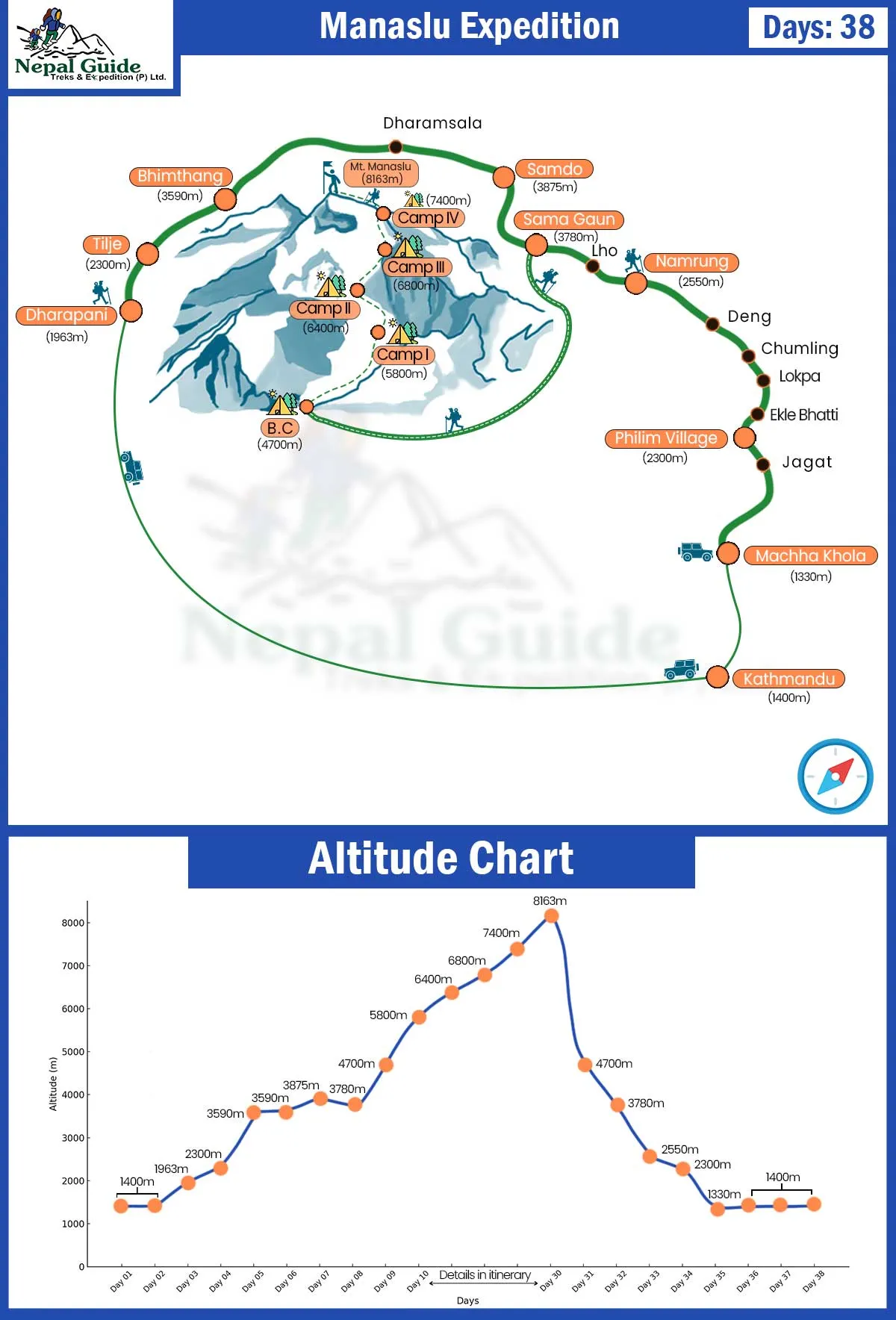
The Manaslu Base Camp approach trek covers one of the most stunning landscapes in Nepal. From Dharapani, you will be directed to small villages like Tilje and Bimthang. You will be given enough time to enjoy the views of lush valleys and mountain ridges while walking along these villages. Above this point, a strenuous climb will take you over the Larkya La Pass, with breathtaking views of Manaslu and other surrounding peaks.
After crossing the pass, the two villages falling en route are Samdo and Sama Gaon. Both villages are rich in Tibetan culture, which gives a glimpse into local mountain lifestyles. Flags line the trails, with ancient monasteries visible. The approach trek itself was a strange sort of adventure since it permitted acclimatization with the high altitude amidst nature’s beauty and cultural experiences. Till you finally reach an altitude of 4,700 meters, the Manaslu Base Camp will be fully acclimatized and ready for the climb ahead.
Location and Background of Mount Manaslu
Mount Manaslu is the eighth-highest peak in the world, at an altitude of 8,163 meters. This majestic mountain is located in the Mansiri Himal range in Gorkha District, which lies in the west-central part of Nepal. It is about 64 kilometers east of Annapurna, lying between the green Budi Gandaki Valley and towering rocky ridges. This position creates a stunning and scenic landscape.
Locals say that the name Manaslu originated from the Sanskrit word ‘Manasa,’ which means ‘soul’ or ‘spirit.’ It is even referred to as the ‘mountain of the spirit.’ This mountain holds deep cultural importance for the people living out there who are from the Gurung and Tibetan ethnic groups. The peaks and areas around Mt. Manaslu host a number of old monasteries and colored prayer flags. Even the sacred stupas represent the deeply rooted Buddhist beliefs and traditions of the people in this area.
Manaslu also falls into the Manaslu Conservation Area, which helps protect various plants and animals. The area provides important biological diversity, including habitats for the snow leopard, Himalayan tahr, and blue sheep. It is located in a very tough and isolated terrain, which trekkers and the locals equally cherish. It is a sight to see and an esoteric destination for worship steeped in deep spiritual meaning to those who venture to its base.
Difficulty Level and Technical Requirements
The climb of Manaslu is quite challenging but highly rewarding. Bad technical conditions and unstable weather on the mountain make the ascent hard. Being one of the highest peaks in the world, it calls for intensive physical and mental preparation.
Manaslu climbing requires experience in alpine climbing. It is not restricted to crevasse rescue and fixed-rope techniques. Higher camps, especially Camp 3 and above, involve steep snow and ice faces. Climbers should be comfortable with using specific mountaineering equipment like crampons, ice axes, and ropes. Dangerous crevasses need to be crossed, and portions of the glacier can shift or change over time.
The altitude factor complicates the climb and makes matters worse. The summit of Manaslu is 8,163 meters above sea level. It is dangerous because of altitude sickness, which has become a major factor. Climbers must be prepared for reduced oxygen levels, extreme cold, and the physical toll of long yet tiring days.
Acclimatization is crucial to avoid altitude sickness. The expedition usually includes a number of rest days so that the climbers can get used to the height. Other prerequisites will also be necessary. It is situated for a high-altitude climbing experience that is particularly harsh and uncompromising for the unprepared.
Most climbers hire a guide or join a team with experienced Sherpas who know the route and the best practices for climbing in extreme conditions.
Required Experience and Skills for Manaslu Climbers
Various skills and experience are required to successfully attempt the Manaslu Expedition. Furthermore, initial basic requirements include sound crampon skills. The person should be confident in using crampons for walking on icy surfaces and steep snow slopes. Another critical skill is rappelling with a pack on because it ensures safety that one can go up and down. You’ll find that it is best when you feel comfortable using ascenders on a fixed line, especially over very steep technical sections.
Besides these technical skills, a sound grounding in alpine living is also necessary. You have to know camping at high altitudes and handle extreme conditions. Snowy ice climbing is essential because you find challenging terrain upward toward the summit. Together with mountaineering experience, it will enable you to take care of difficult situations on the mountain.
You will also need to have great power and endurance. Climbing at high elevations for extended periods requires good physical fitness. It would help if you also had an acclimatization or tolerance to high altitudes wherein the oxygen level is deficient. Strong cardiovascular conditioning also enables you to maintain high energy and stamina during the long climb.
Proper training and experience in those fields will definitely increase your chances of success in the Manaslu Expedition. Therefore, climbers need to be well-trained beforehand for such a daunting adventure.
Physical Fitness and Training Recommendations
Preparing for the Manaslu Expedition requires immense fitness. Before the beginning, you need to focus on endurance, strength and cardiovascular aspects. Since the body cannot adapt in a fortnight, training should be started at least 3 to 6 months in advance to prepare your body for the high altitude demand.
With a ratio of 4 to 5 times a week, you can begin with normal cardio exercises like running, cycling, or swimming. These will give you strength and build up your cardiovascular endurance, something quite necessary for maintaining energy levels when at high altitudes. Remember strength training in your workout. Weightlifters find it soothing. Squats and lunges will also prepare you for the burden of heavy packs and steep ascents. Two to three strength sessions per week can build up a good base.
You will need strong leg and core muscles, as a strong lower body is vital for stability on uneven terrain. Weighted hiking or stair climbing can be good practice because the effect is similar to the strain you will have while on the mountain. Training effectively with a loaded pack on local hikes over weekends is also effective.
Finally, add high-altitude training if possible. Training above 2,500 meters trains your body to live under low oxygen conditions. Finally, consistency and progressive overload have you ready for Manaslu. With proper preparation, you will feel stronger and more resilient, ready to face the challenges of Manaslu.
Popular Climbing Routes on Manaslu
On the Manaslu Expedition, the standard climbing route is regarded as the most popular and widely used track to the summit. The route traces the Northeast Face of Manaslu, starting from Sama Goan and ending at Manaslu Base Camp at 4,700 meters. From here, trekkers advance to higher camps, usually Camp I, Camp II, Camp III, and Camp IV.
One after another while progressively gaining altitude. Each camp serves as a point of acclimatization, rest, and preparation for the next higher camp; Camp IV is placed near 7,450 meters and represents the last high camp before the summit push.
This no doubt makes the normal route somewhat safer and easier to follow, especially for climbers unfamiliar with Manaslu. Fixed ropes are in place across the difficult sections, where the guides and Sherpa support are usually around to help and guide the climber.
Less frequent and pursued by the seekers of alternatives, the Southwest Face is much more technical and seldom used because of the increased risks and steep terrain. Only advanced expert climbers with enhanced mountaineering skills are capable of trying it.
Generally, the standard Northeast Face route remains the best option for any climber because it provides a suitable balance of challenge and safety and ensures a structured route to Manaslu’s 8,163m summit.
Altitude and Acclimatization Schedule
Altitude and acclimatization are some of the major factors that contribute to a safe and successful Manaslu Expedition. It would be best if you gave your body time to accommodate the lower oxygen level while climbing the altitude of 8,163 meters or 26,781 feet above sea level. This itinerary includes acclimatization days to reduce the risk of altitude sickness amidst smoother ascents during this 38-day expedition.
Take an acclimatization day break at Bimthang, situated at 3,590 meters. Your body recovers and completes acclimatization to the gained altitude. For the next day, you will cross Larkya La Pass. One of the highest points of the expedition before base camp. In this trek, you will gradually acclimatize with short treks to get ready for even bigger heights.
You will head to Manaslu Base Camp, located at an elevation of 4,700 meters above sea level, and stay there for 20 to 21 days of your journey. The idea here is a strategy called ‘climb high, sleep low’. You will then be taken up to higher camps but will have to go down again to sleep lower down. The body can adapt better this way with acclimatization at a higher altitude.
The descent also involves acclimatization stops at Sama Gaon at 3,780 meters and Namrung at 2,550 meters. It helps to keep things stable while going down lower in elevation. This is indeed a structured way of acclimatization, which is vital in making the expedition both safe and rewarding.
Pre-Trip Preparation and Gear Checklist
Preparing for the Manaslu Expedition requires a great deal of attention to detail regarding gear and equipment. This high-altitude climb will require clothes and other equipment to withstand intense cold, challenging terrain, and unpredictable weather. Following is a checklist of what one would require.
First, you will want good quality mountaineering boots that fit well and keep your feet warm in extreme cold. They must also be compatible to crampon ensure your safety while moving on ice and snow. On your head, wear a warm hat, a balaclava, and UV-protection sunglasses to protect against extreme wind and sun at high altitudes.
The key to this climb is in layered clothing: start dry with a moisture-wicking base layer, add insulating layers for warmth, and finish with a waterproof outer shell for wind and snow blockage. Camps are higher, and down jackets and thermals are not to be negotiated.
Other needs include trekking poles for balance, a climbing harness, ascenders, and a sleeping bag rated for sub-zero temperatures. Remember to include your first-aid kit and high-energy snacks to keep your strength up. Preparation of this gear will get you going on a much safer and more comfortable expedition.
Permits and Documentation Needed for Manaslu
Due to the protection of most restricted access, a number of permits are essentially required for trekking around the Manaslu Circuit. The Manaslu Restricted Area Permit is needed by anyone trekking in areas such as Jagat, Samagaon, and the villages around. These permits protect the area’s culture and nature from unnecessary access and offer opportunities for good, sustainable tourism.
The cost of permits differs according to season. The first seven days of the autumn season, from September to November, cost US$100, while from winter to summer, it is US$75. Extra days are USD 15 and USD 10. This gives flexibility in time accordingly.
Trekkers in the conservation area also require a permit known as the Manaslu Conservation Area Permit, which costs USD 10 for SAARC nationals and USD 30 for non-SAARC nationals. With this permit, biodiversity and cultural sites will be conserved, offering a chance to see undisturbed surroundings.
As the trek enters the Annapurna Region near Dharapani, it would also be good to obtain an Annapurna Conservation Area Permit (ACAP). The ACAP costs $10 for SAARC nationals and $30 for other nationals; this permit partly supports ecological conservation and trail maintenance.
If you extend your trek to this unique valley, you need a Tsum Valley Permit, which costs $40 per week in autumn and $30 in other seasons. TIMS cards are generally not necessary for Manaslu unless you cross into the Annapurna Circuit.
Similarly, the cost of a Manaslu Climbing Permit during the springtime is $1800. Meanwhile, during the autumn season, it costs about $900.
Option For Package Customization
Although our 38 Days Mt. Manalsu Expedition follows a pre-determined specific itinerary plan, Peak Climbing Nepal also does offer a full customization option for your Himalayan expedition. You can request us to design the most suitable expedition package for you where we can make the activities more flexible and lenient from the trekking part to th alpine scaling. For this customization option, you can either give us a properly planned outline or you can tell us what kind of adventure you want, and we will plan your expedition to suit your taste.
Group Discount
Peak Climbing Nepal’s Manaslu Expedition is one of the best value packages at a reasonable price. However, we also do offer a further discount if you are traveling with a group. The discount rates for expeditions and trekking in Nepal are determined by the size of the groups. Generally, there are three group categories for the discount, and the larger the size of the group, the larger the discount rates: groups of 2 to 4, 5 to 9, and 10+ people.
Private Joining or Group Joining
Your exhilarating Himalayan adventure will follow the pre-determined plans of the itinerary as you gradually get started on the trekking route from Dharapani (1,963 meters) and head toward the mountain. During the trekking part, your exploration will start early in the morning after breakfast, from around 7 AM to 8 AM. Then, you will move along with the trail, checking out the major highlights of the region. Then, after trekking for about 3 to 4 hours, you will reach the lunch stop, where you will rest for about an hour.
After that, you will continue with the reaming part of the trek, which will be short, around 2 to 3 hours. If the daylight is in your favor, you will also have enough time to explore your stop destination; dinner will be typically served from around 6 PM to 7 PM. As for the mountain scaling part, you will traverse short distances along the high camps, acclimatizing properly to the alpine altitude. You will continuously ascend and descend alongside the high camps and engage in practical sessions before pushing for the summit after your mountain guide gives a green signal.
Daily Routine During Manaslu Expedition
This expedition of Peak Climbing Nepal is a completely guided expedition where we will handle all your itinerary plans from the starting date of your arrival to the part where you depart from Nepal. Thus, every transport needs in between; we will take care of them all. During your arrival at the airport, we will arrange a private vehicle to transfer you to the hotel, and during the departure, our representative will drop you at the airport as per your flight schedules. If you need any kind of transport need during the contingency and other days, we can arrange a convenient vehicle for you.
Trip Extension
Mansaslu Expedition takes you to the top of one of the highest peaks in the world. So, definitely the risk of altitude sickness is a concern during this Himalayan adventure. You will get started on the trekking route from Dharapani (1,963 meters) and you will gradually move along the inclining section on the west-central Himalayas. The highest point you will reach on this expedition is the peak of Mt Manaslu itself, which is at an elevation of 8,163 meters ( 26,781 feet). So, the overall altitude gain in the mountain expedition from the trekking route will be about 6,200 meters (20,341 feet). So, you will need to be very cautious of the risk of altitude sickness.
Besides Acute Mountain Sickness (AMS), during an alpine adventure, there are also risks of other severe forms of altitude sickness, such as High Altitude Cerebral Edema (HACE) and High Altitude Pulmonary Edema (HAPE). The severe forms of altitude sickness can be fatal if the proper measures aren’t taken immediately. During your Mt Manaslu Expedition, Peak Nepal Climbing will adhere to all precautionary methods to mitigate the risks of altitude sickness. You will follow proper acclimatization procedures in both trekking trails and slopes of the mountain. You will follow a gradual ascend and adapt properly to the new altitude before heading further. We will also arrange supplementary oxygen and a Portable Altitude Chamber (PAC) wherever needed on the slope during the expedition.
There are a total of six climatic zones that you will cross during this iconic Himalayan expedition. From tropical to trans-Himalayan region, you will face different kinds of climates and temperatures during your adventure. The temperature of the Manaslu region can range somewhere between 8°C to 31°C during the spring season. During the spring, the nighttime temperatures can drop 5°C to -5°C. As for autumn, another high season, the temperatures of the region are pleasant level, ranging from 5°C to 21°C, and the night temperatures can drop to -6°C. These are the temperatures on the trekking trail; on the slope of the mountains, the temperatures are the lowest average during the daytime and are minus degrees during mornings and nights.
Expedtion Difficulty
Altitude Sickness
Mt Manaslu is the eight highest peak in the world. Certainly, scaling one of the 8,000-meter peaks is not an easy task, even if this peak is considered relatively easy in its class. The Manaslu Expedtion has been graded as 4E Peak in the Alpine grading system and is considered one of the most highly challenging and physically demanding expeditions. For a 4E Peak, the climbers need to have all-around fitness and should be capable of coping with the strenuous nature of these high-altitude alpine adventures. Similarly, mental toughness is also an important aspect of long expeditions like this.
The climbers need to navigate their way across steep ice, rock, and snow sections on the mountain using different technical tools and skills. There are some of the longest steep uphill climbs on this mountain, exposed areas, dangerous crevasses, and risks of avalanches. Thus, the climbers need to have a good amount of physical strength, endurance, and mental fortitude, a good amount of experience, and exceptional mountaineering skills to scale this Himalayan peak.
Food and Accomodation
Manaslu region is not a mainstream trekking destination like Everest, Annapurna, or Langtang region. However, despite this region not being a popular mainstream trekking destination and mostly renowned for the off-beat experience, you wil still be able to enjoy a good level of food and accommodation services during your trek. The teahouses along the trailside will provide comfortable bedding facilities where you will also be able to charge your devices, use the internet, bathe, and take care of your laundry. After moving past the trekking trail, our expedition crew will build comfortable tents at the camping site on the mountain.
Our crew will carry all the necessary equipment to build the tent and keep it warm. As for the food, you will be able to enjoy a wide variety of delicacies at the trekking trail, which comprises a diverse menu from cultural dishes to other Asian country dishes and continental favorites. As for the climbing part, the expedition crew will prepare warm and nourishing meals using the packed ingredients.
Training and Preparation
As the difficulty level of the Manaslu expedition is at 4E, which is a highly challenging expedition, you will need a good amount of physical training. You are required to have an optimum level of physical fitness to take on this Himalayan journey, so it is recommended that you train for at least 3 to 6 months or longer, depending on the goal of your fitness level. Technical skills are equally important as there are ice and rock sections on the mountain. So, if you are a beginner, you should definitely take a mountaineering class. By the Nepali law, a beginner also needs to have successfully scaled a mountain in Nepal above 6,500-meters to take part in the expedition of the 8,000-meter class giants.
So, if you are a beginner, you also need to see to those requirements, and if you have experience, you are all good to go. The main focus of your training should be on improving your overall physical endurance level, strength, and core. The stamina and cardiovascular also help a lot when it comes to improving your stamina reserve and adapting properly to rising altitudes.
Things You Should Know?
- World’s 8th highest peak – Mount Manaslu
- Mount Manaslu is considered difficult with several technical sections and extreme challenges to climb.
- Mount Manaslu is also called as “Killer Mountain” of Nepal because of high fatality rate.
- Manaslu peak climbing need climber has excellent physical and mental preparation with a high level of climbing experience.
- It requires highly skilled Sherpa guide with full-sized equipment.
- Manaslu Expedition success ratio is 50/50.
- For mountaineering in Nepal Please bring your insurance coverage for trekking/Mountaineering.