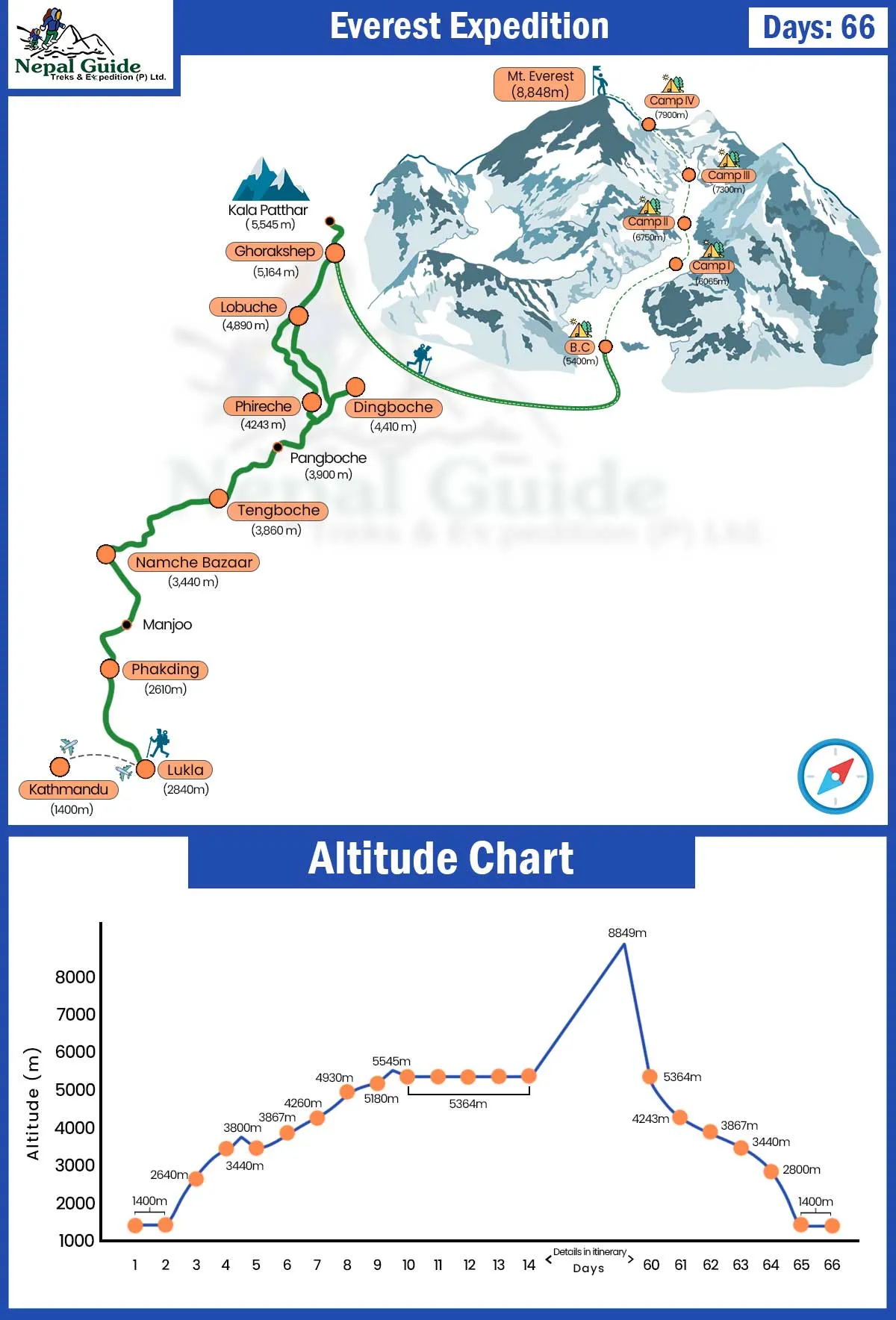
Technical Difficulty of Everest Expedition
Although Mt. Everest has been often referred to as a ‘walk-up’ mountain, the treacherous slopes of the mountain have proved time after time proved how dreadful they can be. It is impossible to successfully ascend to the summit of the tallest mountain in the world without the use of technical equipment and skills. You will be using different mountaineering tools like crampons, axe, carabiners, jumar, ascenders, belay devices, anchors, etc., for a safe and successful scaling of the mountain.
You will also need prior mountaineering experience for the Everest expedition, you will need to be able to use crampons (on snow, ice, and rocks) and fixed ropes with the skills like rappelling and belaying. If you think that the Mt. Everest expedition is similar to ‘trek-up’ peaks, you can’t be gravely mistaken more than that, don’t let its ‘walk-up’ label fool you, it is indeed a difficult expedition that requires a significant amount of technical skillset.
Classifying Mt. Everest Expedition Difficulty Class
Class 1: These are the general hiking trails that lead to Everest Base Camp; you don’t have to use your hands for balance, although these sections can be steep at times.
Class 2: It can be defined as off-trail hiking; although you still don’t need any technical skills, you may have to scramble with your hands for balance occasionally. Descending downhill sections are straightforward and steep in this class.
Class 3: An actual ‘climbing part,’ constant use of hands to scramble and find balance. You will use a fixed route and handhold to climb down facing out from the route.
Class 4: Simple climbing section on the slopes using ropes, handhold, and upper body muscles. Use of rappelling skills and ladders over ice formations.
Class 5: True climbing sections using mountaineering tools like carabiners, harnesses, anchors, ropes, and axe during both ascends and descends.
Best Time For Mt. Everest Climbing
The success rate of this any high-altitude expedition significantly depends on the weather factors. Although the higher-Himalayan altitudes are not predictable, the general data suggests that both peak seasons, spring (March, April, May) and autumn (September, October, November), are relatively the best seasons for the expedition on the tallest mountain in the world.
Even among both of these peak seasons, April to June is considered to be the best time for the Mt. Everest expedition. Also known as the ‘climbing window,’ these months are the warmest in the region, and the spring awakens the true glory of biodiversity the Himalayan region boasts.
On the other hand, the riskiest season for the Everest expedition is considered to be monsoon (June, July, August), when the trails are extremely slippery, which often leads to an inclined number of accidents. Similarly, the winter (December, January, February) comes with its own set of difficulties; the weather is extremely cold during this season, and thick snow covers the climbing trails.
Why It Takes 2 Months for Everest Expedition?
The main reason why the Everest expedition takes about two months is due to the acclimatization process to get used to the high-altitude environment. Physiologically, the majority of the world’s population lives at an altitude ranging between 1,524 meters to 2438 meters; thus, ascending up to an elevation point of even 3,352 meters to 4,267 meters can be a challenging experience for many.
Without proper preparation and precautionary methods, the risks of Acute Mountain Sickness (AMS), High-Altitude Pulmonary Edema (HAPE), and High-Altitude Cerebral Edema (HACE) significantly increase at higher altitudes. As you scale higher on the slopes, the oxygen saturation in the atmosphere gradually decreases, so there is less amount of oxygen for the human body to utilize; thus, properly acclimatizing in such an environment takes time, and it doesn’t happen overnight.
Although it takes approximately 5- 6 days to scale the mountain successfully and descend to the base camp, the two-month bid for the expedition starts after you arrive at the Everest Base Camp (5,364 meters). The acclimatization process takes most of the days of the expedition; after arriving at the EBC, the climbers spend the next few weeks ascending and descending between the base camps on the mountain slopes to properly adapt to the high-altitude environment for the final push to the summit.
During these periods, the food and mountaineering equipment, including oxygen bottles, are moved from lower base camps to higher camps as the climbers slowly ascend to higher base camps adapting to the environment.
Do I Need Previous Climbing Experience?
Successfully scaling the highest snow-clad peak in the world is not an easy feat, regardless of your expertise and experience. Even veteran climbers need to make sure that they are well-prepared for the expedition because the risks and dangers in this glorious adventure are the real deal.
So, if you don’t have prior climbing experience, if not even practice peaks, then this expedition to the top of the world isn’t recommended for you. The Nepal government doesn’t provide climbing permits to Mt. Everest; if you don’t have any prior experience or haven’t climbed a mountain above 6,500 meters in the country. In addition to that, you will also have to submit documentation of your physical fitness and health conditions, climbers are also required to attend basic mountaineering training prior to the expedition.
Previous climbing experience on fixed ropes, rock, steep snow climbing experience, and familiarity with crevasse travel techniques will be a plus point during this expedition. If you are completely new to mountaineering expeditions, you could take mountaineering courses which are approximately 30 to 40 days, and check your capabilities on practice peaks to acquire the necessary skills before th big adventure.
Preparation for Everest Expedition
In general, it is recommended that a trekker should prepare 8- 12 weeks prior to the high-altitude adventure that leads to the foothills of the tallest mountain in the world. So, in this venture that scales the summit of the tallest peak that lasts 6 to 10 weeks (approx 23 months), the preparation should be done considering the magnitude of the glorious adventure.
The standard preparation time for the Everest expedition is around 6- 8 months, but considering the physiology and skills, many mountaineering enthusiasts extend the preparation period for over a year.
In your preparation for the once-lifetime adventure that takes you to the top of the world that is said to trespass even the heavenly realm, there are five points you should emphasize on.
Step 1– Analyze your capabilities
The first step during your preparation period is assessing your own physical abilities; nobody knows better than what you are lacking and what you could work on. You could also consult a trainer or guiding expert for some insights on what you could work on.
It is also important for you to consult with your physician to determine whether you are in perfect condition for this great expedition or not, especially in case you have any medical conditions.
Step 2– Learn mountaineering skills
You will require an advanced level of mountaineering skills for the Everest expedition. If you are a beginner in the mountaineering expedition, acquiring mountaineering skills is the best shot here. All high-altitude mountain climbing demands an advanced level of technical skills, you will need to use different mountaineering tools like crampons, axe, ascenders, anchors, carabiners, jumar, etc.
Normally, these mountaineering classes last about 30 to 40 days, so you will be able to acquire this easily and focus on other practical aspects of your preparation.
Step 3– Physical and mental preparation
Physical and mental preparation are both substantial to make this expedition successful. Although you don’t need to be a professional or a bodybuilder, a basic level of fitness is mandatory for this expedition.
Here are a few notes on physical and mental preparation for the adventure.
Strength training: Push-ups, pull up, planks, deadlifts, bicep curls, squats, and lunges (mostly emphasized on arm and legs muscles)
Cardiovascular training: Cycling, jogging, cardio, swimming, etc
Mental preparation: Controlled breathing and meditation, mental toughness, encouragement, focusing on positivity, and boosting confidence
Step 4– Climb practice peaks
Prior climbing experience is required while scaling high-altitude mountain peaks over 8,000 meters. In Nepal, you need to have experience in climbing mountains at least 6,500 meters to get permission for the Everest expedition.
It might not be entirely possible for you to scale the mountain peaks that are above 6,500 meters. Thus, you can include peaks like Island Peak (6,165 meters), Lobuche Peak (6,119 meters), Mt. Kilimanjaro (5,895 meters), and Mt. Blanc (4,807 meters) for practicing.