
Book Now
Price from
US$2855

Mera Peak Amphu Lapcha

193 reviews in TripAdvisor
30 reviews in Google
Trip Facts
Duration
20 Days
Trip Grade
PD to AD
Country
Nepal
Maximum Altitude
5650 m
Starts
Kathmandu
Ends
Kathmandu
Group Size
2 / 20 PAX
Activities
Trekking Peak
Best Time
Spring and Autumn

Mera Peak Amphu Lapcha Pass Overview

Mera Peak which consists of three peaks, Mera Central (6,461 meters), Mera South (6,064 meters), and Mera North (6,476 meters), is an iconic and exhilarating mountaineering expedition of the Himalayas. Dubbed the ‘highest trekking peak of Nepal’, this beautiful Himalayan adventure offers the exploration of both Hinku Valley and Khumbu Valley. Popular among both seasoned and new mountaineering enthusiasts, the summit of the Mera Peak Central, the expedition peak of this adventure, offers spectacular views of 5 of the tallest 8,000-meter class mountain in the world; Mt. Everest (8,849 meters), Cho Oyu (8,188 meters), Lhotse (8,516 meters), Makalu (8,481 meters) and Kanchenjunga (8,586 meters).

Compared to the general Mera Peak Climbing expeditions, Peak Climbing Nepal’s Mera Peak Amphu Lapcha Pass is a more thrilling and exciting exploration of the secluded part of the Hinku Valley that passes the Amphu Lapcha La Pass (5,845 meters), one of the highest and technically challenging Himalayan passes.

Equipment Needed During Climbing

Related Peak Climbing Packages(6000-6500m Peaks):

Saribung Peak Climbing | Abi Peak Climbing

Highlights

  • Scaling one of the most popular Himalayan peaks, Mera Peak Central (6,461 meters)
  • One of the highest Himalayan passes with technical segment, Amphu Lapcha La Pass (5,845 meters)
  • Unique opportunity to explore both Khumbu and Hinku Valley
  • Beautiful; traditional high-Himalayan settlements across the trail and their warm hospitality
  • Picturesque views of the 5 highest mountains in the world alongside other Himalayan gems like Kongdi Ri, Lumding, Number, Kyashar, and Kusum Karguru
  • Remote secluded trails of the Himlayas on off-beaten less traversed routes enjoying the true magnificence of the region in true solitude
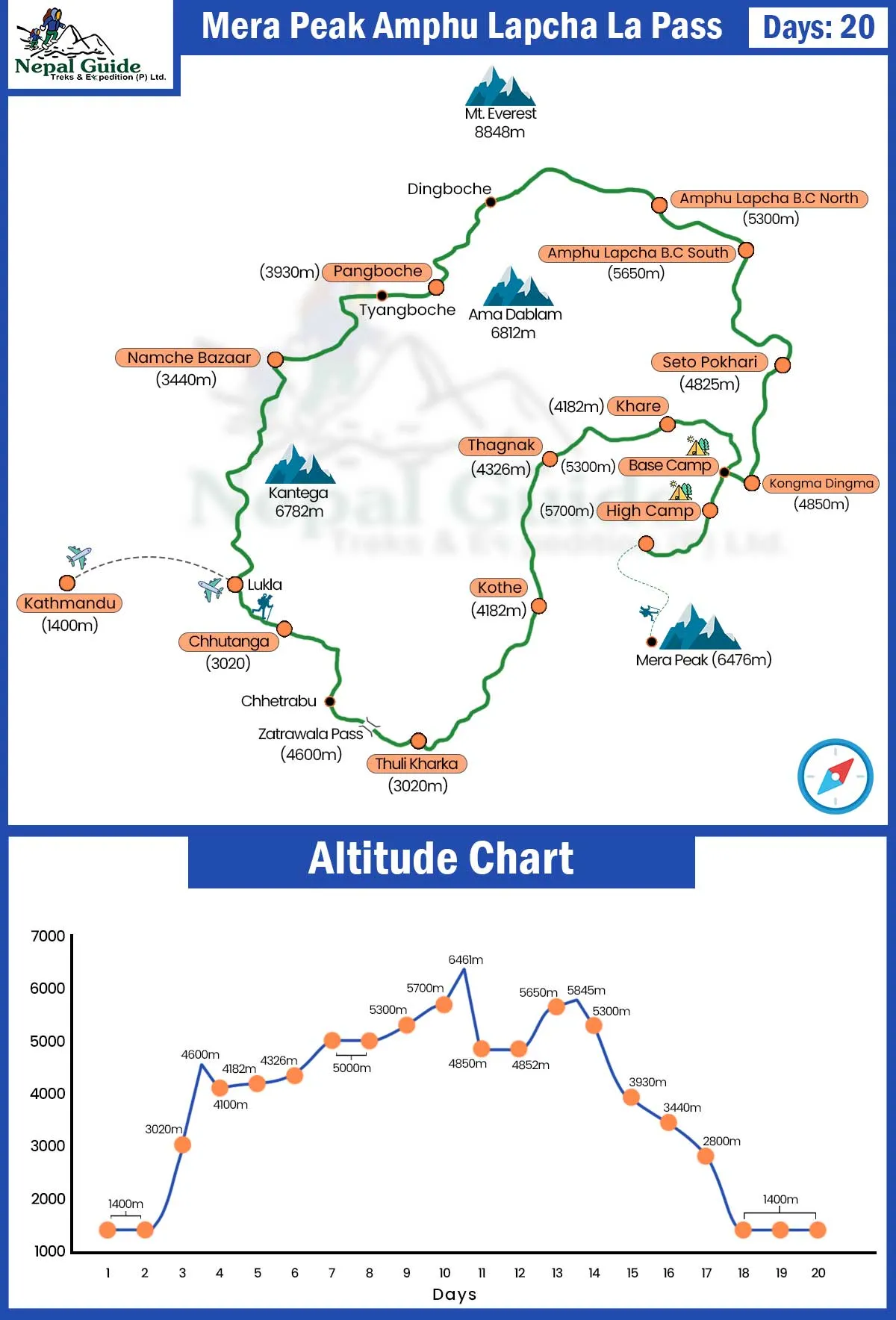
Mera Peak Amphu Lapcha Itinerary

Day 1

Arrival at Kathmandu and hotel transfer

Kathmandu Elevation: 1,345 meters

After your arrival at the Tribhuvan International Airport (TIA) on the firs day of your Mera Peak Amphu Lapcha Pass expedition, our representative will receive you at the airport terminal and transfer you to the hotel. After settling in comfortably, depending upon the time of your arrival, you can use this to stroll around the vibrant capital city and check out popular attractions close to the premises.

Day 2

Kathmandu sightseeing day and expedition preparation

Kathmandu Elevation: 1,345 meters

Day 2 of your adventure will be dedicated to the exploration of this beautiful cultural and traditional valley. You will also do some notable sightseeing of the UNESCO World Heritage Sites located in Kathmandu, 7 out of 10 sites are located in the valley. After this exciting sightseeing adventure in the evening, you will visit the Peak Climbing Nepal’s office where you will be briefed about the upcoming expedition.

By that time we will also arrange all the necessary paperwork and permits required for the expedition. You will meet your expedition leader and guides on this day who will give you the details of the upcoming adventure with helpful tips. If you haven’t bought or rented all the necessary gear for this expedition, you can use this day to buy or rent them for the Mera Peak Amphu Lapcha Pass expedition.

Day 3

Flight from Kathmandu to Lukla and trekking to Chhuthang

Kathmandu Elevation: 1,345 meters
Lukla Elevation: 2,800 meters
Chhuthang Elevation: 3,020 meters
Elevation Gain: 1,675 meters

Your Himalayan expedition will finally begin on Day 3, you will board an early morning flight heading toward Lukla. After landing at Lukla, you will meet the rest of the expedition team here, and after a brief stroll around this Himalayan settlement which is also known as the ‘Gateway to Everest’, you will head east moving toward Chhuthang.

Following the scenic trails of the Dudh Koshi River, you will leave the busy trail of the Everest Base Camp behind as you trek across the lush rhododendron, oak, and pine forests. You will pass several beautiful streams on this day’s trek as you follow the ridge below the Kalo Himal to finally reach Chhuthang, a summer pasture land.

Day 4

Chhuthang to Tuli Kharka trekking via Zatrawala Pass

Chhuthang Elevation: 3,020 meters
Tuli Kharka Elevation: 4,100 meters
Zatrawala Pass Elevation: 4,600 meters
Elevation Gain: 1,580 meters

Day 4 of your Mera Peak Amphu Lapcha Pass expedition, is a challenging day’s trek as you overcome the steep climbing segment to cross the Kalo Himal ridge situated in the Nau Lekh Range. At this point you will finally reach the Hinku Valley leaving behind the Khumbu Valley, you will continue your trek pushing for the Zatrawala Pass.

After overcoming the first pass of your adventure, you will be rewarded with stunning views of the Himalayas like Kongdi Ri, Lumding Himal, Numbur Himal, and other adjacent peaks. Then the moderate downhill descent will lead you to Tuli Kharka, an overnight stay at a lodge.

Day 5

Tuli Kharka to Kothe trek

Tuli Kharka Elevation: 4,100 meters
Kothe Elevation: 4,182 meters
Elevation Gain: 82 meters

It is a relatively short and downhill trek today that passes through admirable rhododendron-patterned hills toward Kothe Kharka. This day’s trekking route drops to the Hinku River and will follow the scenic trail filled with rhododendron, bamboo, and pine trees as you move towards the west side of the Hinku Valley.

In this day’s pleasant walk, you will follow the ridge of the Hinku River all the way to the Kothe, you will rest at a lodge here and prepare for tomorrow’s adventure.

Day 6

Trekking from Kothe to Thangnak

Kothe Elevation: 4,182 meters
Thangnak Elevation: 4,326 meters
Elevation Gain: 144 meters

On this day of your Mera Peak Amphu Lapcha Pass expedition, you will again follow the ridge of the Hinku River moving towards Thangnak. During the first section of this day’s trek, you will follow the rocky trail and steady gradual climb up the valley, then after reaching the pastures above the river level, you will trek on leveled pasture lands.

You will pass the ancient monastery Gondishung and the summer herder’s settlement at the banks of the Hinku River on the west on this day’s trek. You will also e able to enjoy the superb view of Mera Peak, Kyashar, Kusum Karguru, and other peaks as you move along the trail toward Thangnak.

Day 7

Thangnak to Khare trek

Thangnak Elevation: 4,326 meters
Khare Elevation: 5,000 meters
Elevation Gain: 674 meters

This day’s trek passes through stunning landscapes that sum up perfect vistas of the Himalayas. You will trek up to the Dig Glacier and Charpati Tal as you move toward the east alongside Dig Kharka, the stunning views of the Himalayan gems like Mera Peak, Charpati Himal including several others will make this day’s adventure really picturesque.

During the last stretch, you will trek cross the Hinku Nup and Lhotse Shar Glaciers following the steep moraines as you switch toward the boulder-strewn trail that takes you to Khare.

Day 8

Acclimatization day at Khare

Khare Elevation: 5,000 meters

Although you have been enjoying a slow-paced adventure acclimatizing properly and adapting to the increasing altitude through the trek. As you have reached an elevation point of 5,000 meters, Day 8 will be your first acclimatization in the Mera Peak Amphu Lapcha Pass expedition.

As it is recommended to do some physical activity rather than just staying idle during the acclimatization period, you can use this day to do some side detours of the region and for mountaineering gear inspection as your mountain expedition will commence tomorrow.

Day 9

Trekking from Khare to Mera Base Camp

Khare Elevation: 5,000 meters
Mera Base Camp Elevation: 5,300 meters
Elevation Gain: 300 meters

The big day of your Mera Peak Amphu Lapcha Pass expedition that you have been eagerly waiting for is finally here, today, you will trek toward Mera Base Camp following the rocky-boulder-strewn path toward the glacier that leads to the mountain. After arriving at the glacier, you will suit up for the alpine terrains and move toward the base camp.

Our Sherpa expedition crew will set up camp at a suitable spot after you arrive at the Mera Base Camp and also make all the necessary arrangements on the mountain for the expedition. Then, for the remaining part of the day, you will do the preparation for the climb starting tomorrow.

Day 10

Mera Base Camp to Mera High Camp

Mera Base Camp Elevation: 5,300 meters
Mera High Camp Elevation: 5,700 meters
Elevation Gain: 400 meters

Your ascending on the slope of Mera Peak will officially begin on Day 10 of your Mera Peak Amphu Lapcha Pass expedition. Today, leaving the base you will push for the high camp on the slopes of Mera. Overcoming the rocky and snow segments along the route, you will arrive at the Mera High Camp.

From its vantage point, you will be able to enjoy the magnificent views of the Himalayan massifs like Everest, Lhotse, Nuptse, and Makalu. After arriving at the high camp, our expedition crew will set up tents at a feasible location and do a throughout health evaluation to check how well your body is adapting to the alpine environment.

Day 11

Mera Peak summit day and trekking down to Kongma Dingma

Mera High Camp Elevation: 5,700 meters
Mera Peak Summit Elevation: 6,461 meters
Kongma Dingma Elevation: 4,850 meters
Elevation Gain: 761 meters

On the Day 11 of your Mera Peak Amphu Lapcha Pass expedition, you will finally push for the summit of the mountain. You will start this day’s adventure really early in the morning as the afternoon’s strong winds make it almost impossible to scale all the way to the summit. Although Mera Peak climbing is a non-technical climb, the rising elevation with thinning air will be a major challenge, so it will be a slow-paced scaling as you push for the summit.

From the top of this glorious peak in the Himalayas you will be able to enjoy a panoramic vista of the mountain ranges from Everest, Lhotse, Kanchenjunga, Nuptse, Baruntse to Haling, Naulekh, and Makalu looming at the back. Relishing the magical moments at the summit of the Mera Peak you will retrace your steps back to base camp. From there you will trek down to Kongma Dingma for an overnight stay.

Day 12

Kongma Dingma to Seto Pokhari trek

Kongma Dingma Elevation: 4,850 meters
Seto Pokhari Elevation: 4,825 meters
Elevation Loss: 25 meters

After the successful conquest of Mera Peak, on Day 12 of your Mera Peak Amphu Lapcha Pass adventure, you will leave Kongma Dingma behind and head towards Seto Pokhari following the remote upper yak pasture. During the final part of this day’s trek, you will ascend a snowy moraine and head for the Seto Pokhari.

This day’s trek will be blessed with stunning views of Everest and Lhotse as you move towards reaching the first lake of the Honku Basin. You will have an overnight stay at a tented camp at the lakeside.

Day 13

Trekking from Seto Pokhari to Amphu Lapcha Base Camp (South)

Seto Pokhari Elevation: 4,825 meters
Amphu Lapcha Base Camp Elevation: 5,650 meters
Elevation Gain: 825 meters

This day’s trek will continue to proceed toward the remote isolated part of the Himalayas that Honku Valley is known for. Following the off-beaten outlying path, you will ascend just beyond the Seto Pokhari. During the final stretch of this day’s adventure, you will cross the Hongu Pokhari and experience the isolated wilderness of the Himalayas as you push for the Amphu Lapcha Base Camp (South). Overnight stay at the Amphu Lapcha Base Camp.

Day 14

Trekking to Amphu Lapcha Base Camp via Amphu Lapcha La Pass

Amphu Lapcha Base Camp Elevation (South): 5,650 meters
Amphu Lapcha Base Camp Elevation (North): 5,300 meters
Amphu Lapcha La Pass Elevation: 5,845 meters
Elevation Gain: 195 meters

Following the steep ice and rock, today you will cross a technically challenging Himalayan pass, Lapcha La Pass. As this pass is often covered with snow and ice, it is necessary to move cautiously, you are likely to use climbing ropes wherever it is deemed necessary. This day’s adventure starts early in the morning as the sunlight melts the snow along the route making it harder to overcome.

After overcoming the victory over the snow-shelved route to Amphu Lapcha La Pass, you will descend down on a fixed line that leads to the moraine and gradually towards the Amphu Lapcha Base Camp (North). Overnight stay at a tented camp in the base camp.

Day 15

Amphu Lapcha Base Camp to Pangboche

Amphu Lapcha Base Camp Elevation (North): 5,300 meters
Pangboche Elevation: 3,930 meters
Elevation Loss: 1,370 meters

From this day onwards trek will follow the descending route to the starting point of this adventure. On the Day 15 of your Himalayan exploration, your Hinku Valley adventure will finally reconnect to the Khumbu Valley.

You will get the opportunity to soak the spiritual realm of the Pangboche Monastery at the end of this day’s trek, which is believed to be the oldest monastery in the Khumbu region. After numerous days of camping accommodation, this day’s trek will be a delight as the fine dinner and sleeping arrangement of the warm teahouse in Pangboche marks the closure of this day’s adventure.

Day 16

Trekking down to Namche Bazaar from Pangboche

Pangboche Elevation: 3,930 meters
Namche Bazaar Elevation: 3,440 meters
Elevation Loss: 490 meters

Leaving the Himalayan vistas behind, the greenery will resurface on the Day 16 of your Mera Peak Amphu Lapcha Pass expedition. The first segment of this trek will lead an uphill climb to Tengboche, after a brief visit of the Tengboche Monastery, the path will make steep dive to the Dudh Koshi River. Then moving along the lush rhododendron, pine, and fir forest parts of the trail, you will reach the army camp of Namche Bazaar; the final stretch of this day’s trek is a steep climb on the hill that leads you to the vibrant Sherpa Capital.

You can enjoy the modernity this Himalayan settlement has to offer after a long tiring expedition. Overnight stay at the finest teahouse in the region.

Day 17

Namche Bazaar to Lukla trek

Namche Bazaar Elevation: 3,440 meters
Lukla Elevation: 2,800 meters
Elevation Loss: 640 meters

Finally, concluding the Himalayan expedition, now it’s time to move to the starting point of this adventure. After a healthy breakfast at Namche Bazaar, you will make a return to the Dudh Koshi Valley. You will cross the Bhote Koshi River several times as you move along the trail and the last segment, about 45 minutes of uphill climbing will finally bring you to the ‘gateway of the Everest’.

After arriving at Lukla, we will celebrate our successful Mera Peak Amphu Lapcha Pass expedition at this final Himalayan stop point of this adventure.

Day 18

Fly back to Kathmandu from Lukla and transfer to the hotel

Lukla Elevation: 2,800 meters
Kathmandu Elevation: 1,345 meters
Elevation Loss: 1,455 meters

Bidding farewell to the Himalayan region, you will board an early morning flight from Lukla to Kathmandu. During this short scenic flight, you will be able to enjoy the aerial views of stunning Himalayas as you leave them behind and fly over the valley heading toward the capital.

After your arrival in Kathmandu, our representative will drop you back at your respective hotel; get rest, and if you feel like it, you can also do some sightseeing around the capital. Or, simply stroll around the city checking out restaurants- cafes and enjoying the nightlife.

Day 19

Leisure and rest day at Kathmandu

Kathmandu Elevation: 1,345 meters

As it is not possible to completely explore the Kathmandu Vally in your sightseeing day Mera Peak Amphu Lapcha Pass expedition, you can use this day to explore the remaining tourist highlights of the capital. You can start early exploring the religious sites and move on towards the cultural and traditional parts, Patan, Bhaktapur, Kathmandu Durbar Square, Thamel, etc are some of the most popular destinations if you want to collect souvenirs to treasure this remarkable adventure.

In the evening, we will also host dinner to celebrate your successful Himalayan adventure and our partnership. Overnight stay at a star hotel in Kathmandu. 

Day 20

Departure day

Kathmandu Elevation: 1,345 meters

It is time to part ways, although it was brief we hope you enjoyed this iconic Himalayan expedition. Our representative will pick you up at your hotel, assist with the check-out process and drop you at the airport depending on your flight schedule. It is recommended that you should arrive at least 3 hours prior to your scheduled flight at the airport.

We hope to see you again. Have a safe journey back home!

Cost Details

What’s Included

  • Airport Arrival and Departure Transfer by Private Vehicle
  • 3 nights stay in Kathmandu with BB Plan
  • A day sightseeing in Kathmandu with an experienced city guide, all entrance fees, and private vehicle
  • Kathmandu – Lukla – Kathmandu flight
  • All essential ground transportation by private vehicle
  • Climbing permit for Mera Peak
  • All required trekking permits and national park fees
  • Tea House + Camping combined accommodation during the trek – as per itinerary
  • All meals during trek & climb– Breakfast, Lunch, and Dinner
  • Experienced Trekking and Climbing Guide
  • Required number of porters
  • Necessary set of climbing gears
  • Kitchen equipment and camping equipment during the climbing period
  • General first aid kits
  • Insurance, clothing, and salary for staffs
  • Welcome and farewell dinner in Kathmandu
  • All government taxes and necessary paperwork

What’s Excluded

  • Medical/personal high-risk insurance (suggest have rescue coverage policy as well)
  • International airfares and departure tax
  • Personal climbing gears
  • All kinds of drinks
  • Cost of personal expenses
  • Tips for staffs

Private Trip

Fixed Departure is for joining pre-scheduled group departures.

Private Trip is for personalized experiences.

Essential Information

Best Season for Mera Peak Amphu Lapcha Pass

The best season for any high-altitude adventure in Nepal is considered to be during the peak seasons of autumn (September- November) and spring (March-May). The weather is on the warmer side during this season with more stable climatic conditions, days are longer and bright making it the perfect time for the Mera Peak Amphu Lapcha Pass expedition. The temperature of the region is at 15°C- 20°C during the springtime with changes dropping up to -8°C at night and early morning. Similarly during the autumn seasons, the temperature hovers around 10°C to 20°C and start to get relatively as the winter closes by.

Mera Peak Amphu Lapcha Pass expedition is also doable throughout the year however, off-seasons like winter (December- February) and monsoon (June- August) add up the challenging factors to this Himalayan expedition. The trails are slippery and wet with the risks of landslides, whereas, the harsh winter of the region covers the whole trail in snow, with the temperature constantly dropping to minus degrees. So, if you are a beginner it will be ideal if you stick with the peak seasons for this expedition.

Mera Peak Amphu Lapcha Pass | Technical Part

Although Mera Peak is labeled a ‘non-technical’ mountain’, and it is pretty much a straightforward trek to the summit. There are still some little technical segments on the slope of the mountain that you have to overcome. During the last segment of the summit, the climbers have to use jumar on the fixed rope to overcome a snowy dome section 40-50 meters in front of the summit.

From the climbing aspects, the Mera Peak expedition has been graded an ‘Alpine Grade PD’ in the Alpine grading system which means that there are some challenging and difficult sections on the slopes of the mountain. Similarly, it has received a ‘Moderately Difficult’ level in the Himalayan grading system. Although you don’t need to be a mountaineering expert for this Himalayan expedition, you will still need to learn adequate mountaineering skills and required to have a good level of physical fitness. You also need to use rope while overcoming the Amphu Lapcha La Pass, which is considered one of the highest and most technical passes in the Himalayas.

You may also like:

Customize Trip
Price From
US$2855

Frequently Asked Questions

Fitness and Experience
Is Mera Peak hard to climb?

Although you don’t need polished technical skills to successfully scale Mera Peak, the significant altitude gain can make the expedition quite challenging.

Can a beginner climb Mera Peak?

Labeled the ‘highest trekking peak in Nepal’ the Mera Peak climbing is perfect for beginners who want to prepare for a big expedition on the highest mountains in the world.

Is Mera Peak harder than Kilimnajaro?

Although both Mera Peak and Kilimanjaro are trekking peaks, the high elevation point of the Mera Peak expedition in a completely alpine setting makes it more challenging.

Need Help? Call Us+977 9851029613