
Book Now
Price from
US$3185

Kyajo Ri Peak Climbing

199 reviews in TripAdvisor
34 reviews in Google
Trip Facts
Duration
17 Days
Trip Grade
PD to AD
Country
Nepal
Maximum Altitude
6,186m
Starts
Kathmandu
Ends
Kathmandu
Group Size
2 / 20 PAX
Activities
Trekking Peak
Best Time
Spring and Autumn

Kyajo Ri Peak stands tall at 6,286 meters (20,296 feet) above the sea level. Located in between the Khumbu region and Gokyo Valleys, Kyajo Ri is a challenging peak to climb. This trekking peak is relatively less climbed when compared to other peaks in the Everest region. However, the ascent of the Kyajo Ri Peak undoubtedly provides the excitement of climbing a semi-technical peak above 6,000 meters.

Kyajo Ri Peak falls between 27.9106 degrees North latitude and 86.7193 degrees East longitude in approx. The initial ascent to the Kyajo Ri summit was successfully made in the year 2002. The challenges and complexities of the peak came to the limelight then after. Kyajo Ri Peak climb involves several difficult and technical sections to overcome, like the ice and rock climbing. Its successful ascent demands mountaineering skills and techniques with considerable experience in high-altitude adventure. This difficulty level marks Kyajo Ri as suitable for seasoned mountaineers.

Kyajo Ri is located within the Sagarmatha National Park, a UNESCO World Heritage Site. It consists of diverse flora and fauna, which offers trekkers a substantial inspection of the local ecosystem. Kyajo Ri trekking journey passes through this amazing Sagarmatha National Park and crosses several Sherpa Villages. Trekkers can get an opportunity to interact with the localities and gain insights into the unique culture and traditions of the region. Once summiting the Kyajo Ri Peak, climbers are blessed by the amazing panoramic views of the magnificent mountains, which include the giant Mount EverestLhotse, Cho Oyu, MakaluAma Dablam, and many other towering peaks in the Himalayas.

Equipment Needed During Climbing

We also offer multiple peak climbing adventure packages: Three Peaks Climb Island Lobuche and Kyajo Ri

Related Peak Climbing Packages(6000-6500m Peaks):

Bokta Peak Climbing | Kusum Kanguru Peak Climbing | Phari Laptsa Peak Climbing

Highlights

  • The trek passes through the beautiful Khumbu Valley, where you encounter blooming rhododendron forests, picturesque villages, and high-altitude terrains.
  • Explore the customs and traditions of the Sherpa people and get insights into their art and culture by visiting the ancient monasteries.
  • Prospect the diverse flora and fauna of the Sagarmatha National Park, a rich and fascinating insight into the local ecosystem of the Everest territory.
  • The Base Camp experience involves setting up the base camp at a magnificent high-altitude Himalayan location encircled by giant towering peaks.
  • The Kyajo Ri Peak involves a challenging climb needing technicalities and mountaineering skills. Navigating the steep slopes and difficult ridges and passing through the ice and rock climbing segments finally offers a rewarding summit victory.
  • An opportunity to inspect the pristine wilderness of the remote area in the Everest region. Trekking provides insights into the off-the-beaten-path, whereas the climb offers a sense of accomplishing a memorable adventure.
  • A quiet and tranquil journey in the high Himalayas. Kyajo Ri Peak offers a sense of solitude and a secluded mountaineering experience.

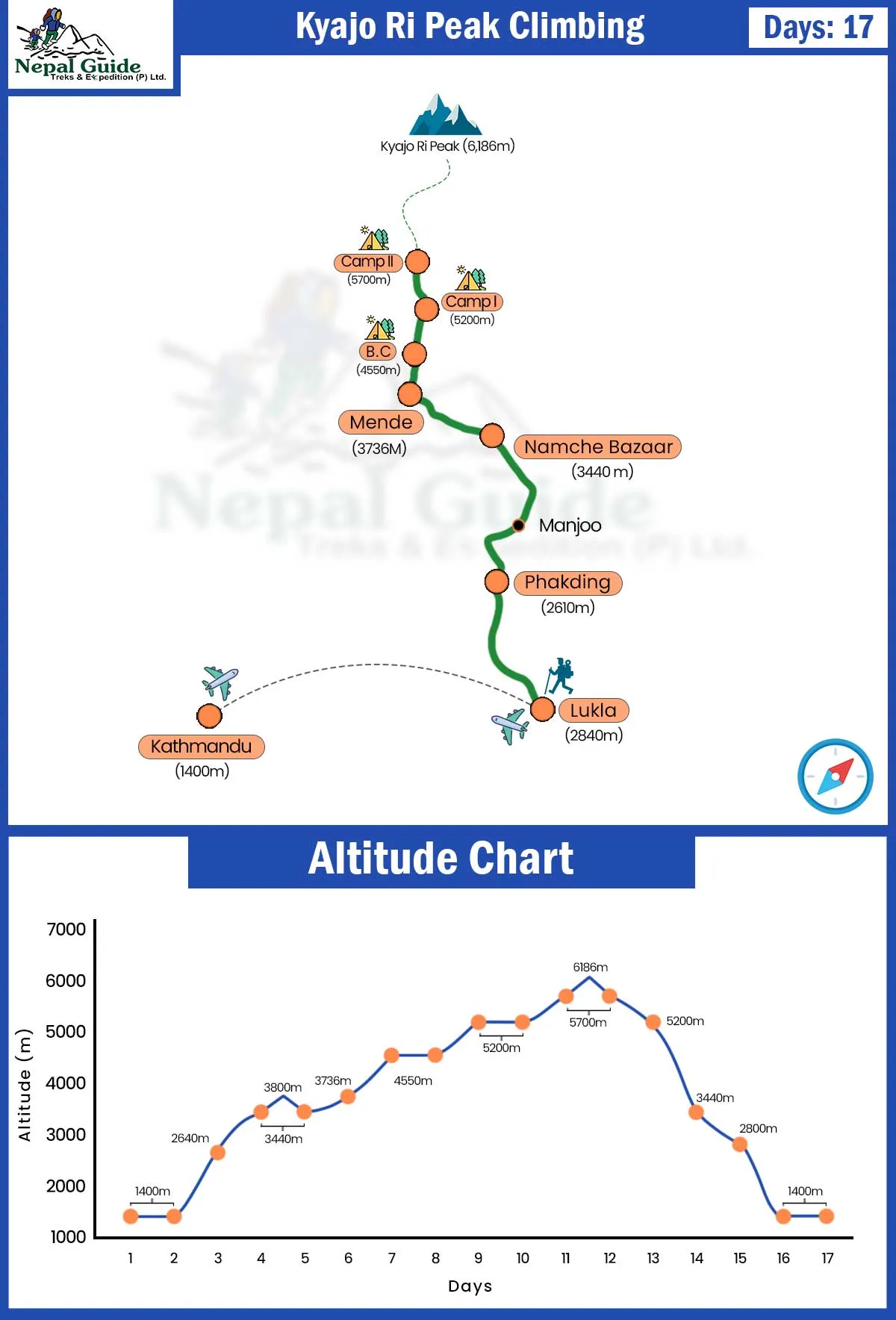
Kyajo Ri Peak Climbing Itinerary

Day 1

Arrive at Kathmandu [1,345meters/4,411feet] and Transfer to Hotel

Upon your arrival at the Tribhuwan International Airport, airport representative staff from Peak Climbing Nepal will greet and meet you. He/she will be on standby with a personal vehicle to transfer you easily to your hotel in Kathmandu. Once reaching the hotel, our staff will help you with the check-in process and inform you about your stay.

Now, you can relax in a hotel and have a refreshment time. Thereafter, if you are interested, interact with your fellow trekking members and participate in our concise pre-briefing session. During pre-briefing, you will be informed of comprehensive details on the adventure. You get to know about the trekking and climbing gear, safety protocols, and meals and accommodation provided during the journey. You can participate in a welcome dinner event during the evening, which also denotes a symbol of journey initiation.

Day 2

Sightseeing in Kathmandu and Journey Preparations

Click here for detailed information about World Heritage Sites of UNESCO in Kathmandu 
Day second is the sightseeing and journey preparation day. You can take a short trip to the heritage sites to explore the cultural and historical importance of the Kathmandu Valley. Witness the amazing scenery of the valley, visit historic Durbar Squares, Pashupatinath Temple, and the stupas of Syambunath and Buddhanath.

Traveling in the comfort of private transportation, get immersed in the city’s magnificence. Gain insights into the religion and fine details of the valley’s tradition under the guidance of our knowledgeable guide. Have delicious breakfast and lunch at local restaurants, relishing the authentic flavors. After a wonderful city visit, arrive back at the place of your stay. Take time for final preparations before the upcoming journey of stunning Kyajo Ri Peak.

Day 3

Flight from Kathmandu to Lukla [2,800meters/9,184feet] and trek to Phakding [2,640m/8,659ft]

Start your journey by taking a luxurious flight from Kathmandu to Lukla. Your journey has now started with a thrilling adventure, flying over the spectacular Himalayas. Once you get off at Lukla, inhale the fresh mountain air. Gradually, from the gateway of the Everest region(Lukla), our trekking journey starts towards the beautiful village of Phakding. We will walk through the beautiful trekking routes imbued with the natural beauty of Everest. This so far journey offers a mixed progressive experience, including aerial wonder and step-up mountain exploration.

Duration: 25-30 minutes
Distance: 136 miles
Day 4

Trek from Phakding to Namche Bazaar [3,440meters/11,283feet]

After arriving at the charming Phakding village and spending a night there, the next day, a tranquil walk explores the winding roads to Namche Bazaar. As we walk through the stunning forests heavily bloomed with rhododendrons, surrounding beauties and awesome peaks of the Himalayas relieve the harsh trekking journey.

Crossing several suspension bridges and immersing into the Himalaya’s mesmerizing vistas, Namche Bazaar comes into view. The vibrant market of the Namche Bazaar offers a warm welcome and comfortable accommodations for a stay. The trekking trail from Phakding to Namche Bazaar represents a harmonious blend of natural beauty with cultural conventions.

Duration: 5-7 hours
Distance: 9 km
Day 5

A Day for Rest and Acclimatization at Namche Bazaar

Namche Bazaar is a popular stop for trekking in the Everest region. We will be over 3,000 meters altitude, once reaching at the Namche Bazaar. This marks the acclimatization as crucial to avoid possible altitude sickness. We will spend a day at Namche Bazaar to acclimate to the increasing height. You get to know the locals and their lifestyle by interacting and visiting the places of importance, like monasteries. Acclimatize to the altitude of the unique atmosphere while on a short hike to the surroundings of Namche Bazaar. Identify and explore the sights and cultural riches of Namche Bazaar.

Day 6

Trek to Mende from Namche Bazaar[3,736meters/12,255feet]

After a productive stay for a day at Namche Bazaar, we head towards our next destination, Mende. To reach Mende, we follow the trail that leads by the magnificent Himalayan scenery with forests filled with Rhododendron blossoms and diverse high-mountain topographies. Mende is a high-altitude settlement, requiring a slow pace and acclimation stops from the time being. As you ascend further, you will be met by the rugged Himalayan topographies. Navigating through the valley and waterfall, we finally reach Mende.

Duration: 5-6 hours
Distance: 9-11 km
Day 7

Trek from Mende to Base Camp [4,550meters/14,925feet]

From Mende, the trek journey will follow a fine yak trail that reveals the solitary beauty of the Kyajo Drangaka Valley. An awe-inspiring panoramic vistas of the high-altitude Himalayas nearby tugs at our concentration. After several hours of trek, we will arrive at a tranquil area, which will be our campsite. There, we(our expert team) set up the base camp for the Kyajo Ri Peak climb. Usually, the base camp is set up 4,550 meters in a secluded flat area of a rocky mountain and a nearby river.

Duration: 5-6 hours
Distance: 10-12 km
Day 8

Rest and Acclimatization Day at Base Camp

We will have a leisure day at the base camp on this day. Resting day at Kyajo Ri Base Camp offers magnificent scenery of the nearby Himalayan peaks. Allow yourself to immerse in the tranquil, high-altitude Himalayan environment. The base camp is set up at a significant height of over 4,550 meters, posing a high chance of altitude issues. Acclimatize well by taking short hikes and time to explore the surroundings in the base camp. Involve in light physical exercise and cardiovascular training. Ensure after the proper rest and acclimatization, to head towards Kyajo Ri Camp I, at more higher location.

Day 9

Ascend from Base Camp to Camp I [5,200meters/17,056feet]

The ascend from the Kyajo Ri base camp to the first camp is challenging and involves a considerable climb over higher ground. You should pass through the high-altitude steep slopes and rugged mountainous terrains. Wait and ensure appropriate environmental conditions for the ascent. We use appropriate climbing routes by maintaining safety procedures to reach Camp I efficiently. Navigate the hurdles and continue on a gradual ascent to successfully reach Camp I. Before heading further to the higher altitudes, staying at Camp I, acclimatizing, and preparing for the climb is essential.

Day 10

Rest and Acclimatization Day at Camp I

Upon reaching the Kyajo Ri Camp I, we will pause our Himalayan trekking for a while and spend a day and night there. Camp I at Kyajo Ri is an important adaptation zone, where you can rest and acclimatize to the altitude. Spend a day at Camp I, relishing the panoramic beauty of the high-altitude Himalayas. Stay hydrated, rest, and engage in lighter physical activities. You can take short hikes to the surroundings to acclimate, being aware of the potential signs of altitude sickness. This strategic rest and acclimatization break at Camp I prepares and enables you for the later part of the climb.

Day 11

Ascend from Camp I to Camp II [5,700meters/18,700feet]

After having rested and acclimatized at Camp I, we will start the early ascent to Camp II. The ascent involves challenging sections, requiring equipment like crampons and fixed ropes. You have to navigate the steep rock and glacier parts of the climb to reach the high-altitude Camp II. Spend the remains of the day and a night at Camp II. Focus on good hydration, acclimatization and make necessary preparations for the climb. Review the gear condition and prepare mentally and physically to summit the Kyajio Ri Peak the next day.

Day 12

Summit the Kyajo Ri Peak [6,186meters/20,290feet] and descend to Camp II

After ensuring the proper acclimatization, we start early to the summit. The strong mountain winds after noon can disrupt the climbing journey. With the guidance of a climbing expert, we follow an early start and navigate the climb challenges to reach the Kyajo Ri summit. After the rush to the sharp summit of Kyajo Ri, the result of a tiring climb is celebrated by the awe-inspiring panoramic vistas of the towering giants. The breathtaking scenery of the majestic Everest, Cho Oyu, Ama Dablam, Makalu, and other high peaks is offered from the top of Kyajo Ri. After being blessed by this Himalayan allure, make a way back, retracing the challenging sections downward to Camp II.

Day 13

Back to Base Camp from Camp II

With the joy of successfully summiting the Kyajo Ri Peak, gradually descend to Base Camp. Accompanied by a celebratory heart, filled with a profound sense of accomplishment, enjoy the journey downward following the same trail. You can have a different perspective of Himalayan terrains this time, with a chance to gaze upon the missed-out magnificence. After 4-5 hours of continuous downhill trek, we will reach the base camp and take a chill pill. The final overnight camping at the Kyajo Ri Base Camp offers a tranquil opportunity to reflect and experience the journey so far.

Day 14

Trek to Namche Bazaar from Kyajo Ri Base Camp [3,450meters/11,316feet]

Start your way back journey from Kyajo Ri Base Camp to Namche Bazar. The trek involves retracing steps along the same route while making the ascent. Trek back simultaneously from the higher campings through the beautiful alpine mountainous terrains to the sub-tropical regions. Relish the charming mountain views of the descending journey. Emphasis on the gradual descent, taking time for rest, and acclimatization. Arrive back at Namache Bazaar to taste the lowlands.

Duration: 7-9 hours
Distance: 20-22 km
Day 15

Trek from Namche Bazaar to Lukla [2,800meters/9,184feet]

Start a scenic journey from the high altitudes of Namche Bazaar to lower elevations. The trek to Lukla involves a descent through captivating villages. On the way, we navigate the Dudh Koshi River and bypass several suspension bridges. Walking through rhododendron-filled lush forests, we reach Lukla.

In Lukla, you can enjoy the Himalayan perspectives earlier than leaving the mountainous location. Concluding the high-altitude Himalayan adventure of Kyajo Ri Peak Climbing, we set up to escape Kathmandu the next day. The final day at the Mountain region will be celebrated, in the success of Kyajo Ri Peak Climbing with all team members.

Duration: 6-8 hours
Distance: 18-20 kilometers
Day 16

Fly from Lukla to Kathmandu

This day, we start an early morning flight departing from Lukla to Kathmandu. The flight involves scenic views of the Himalayas summit from above the clouds. This short and daredevil flight provides you with a miraculous experience. After returning to Kathmandu, you will be comfortably transferred to the Hotel. Spend quality time resting and reflecting on your journey. During the afternoon, you can visit the remaining beautiful sites of the valley, including UNESCO World Heritage Sites. Spend your quality time walking around th busy streets of Kathmandu city and savor the local and traditional cuisines. In the evening, join a farewell dinner party to celebrate a successful adventure.

Day 17

Transfer to the International Airport for departure

This is your last day in Nepal. How did it feel to explore the untamed Himalayan beauties and experience the adventurous journey of Kyajo Ri Peak climbing? We expect you to leave acquainted with a positive and marvelous experience. Our member of airport representative accompanies and drops you at the Airport for your departure.

Dates & Availablity

Fixed Departure is for joining pre-scheduled group departures.

Private Trip is for personalized experiences.

Sep 2026
Oct 2026
Nov 2026
Starts
03 Sep, 2026
Ends
19 Sep, 2026
Status
Guaranteed
Price
US$3185
Starts
14 Sep, 2026
Ends
30 Sep, 2026
Status
Guaranteed
Price
US$3185
Starts
21 Sep, 2026
Ends
07 Oct, 2026
Status
Guaranteed
Price
US$3185
Starts
24 Sep, 2026
Ends
10 Oct, 2026
Status
Guaranteed
Price
US$3185
Starts
29 Sep, 2026
Ends
15 Oct, 2026
Status
Guaranteed
Price
US$3185

Equipment Lists for Kyajo Ri Peak Climbing

Explore our complete packing list for 6000m and 6500m peaks of Nepal. We’ve also detailed the gear provided by our company, along with items available for hire.

Essential Information

What permits are required?

Permits are the essential documents for trekking in the pristine and secluded high-altitude Himalayas and to climb the mighty peaks there. These are the major permits required for the Kyajo Ri Peak Climbing.

Sagarmatha National Park Entry Permit

Kyajo Ri Peak is located in the Everest region, which requires trekking through the Sagarmatha National Park. This permit is mainly required for entering the Park. The cost of the Sagarmatha National Park Entry Permit is NPR 3,000.

TIMS card

TIMS (Trekker’s Information Management Service) is required for most of the treks in Nepal. The TIMS card is issued for the safety of each trekker trekking in the Himalayas. Sometimes, accidents may occur in the mountains, and the information can be generated with the help of a TIMS card to run a rescue operation. TIMS card costs NPR 2,000, which is equivalent to $15.

Khumbu Pasang Lhamu Rural Municipality Entry Permit

Trekking in certain areas requires additional permits from the local municipality, including the Kyajo Ri Peak. A Khumbu Pasang Lhamu Rural Municipality Entry permit is required for trekking and climbing of the Kyajo Ri Peak in Solukhumbu of the Everest region. This permit for local area entry and trekking costs $ 20 to $ 25 per person/week, depending on the time of trek.

Permit fee for climbing Kyajo Ri Peak

Kyajo Ri Peak climbing requires a separate permit fee, especially in order to climb the peak. The cost of this semi-technical peak, majestically standing over 6,000 meters in the Everest region, is USD 250 in Spring, USD 125 in Autumn, and USD 70 each in the summer and winter seasons.

How Difficult is Kyajo Ri Peak Climbing?

Kyajo Ri Peak climbing is a difficult mountaineering expedition involving considerable high-altitude technicalities. As Kyajo Ri Peak is a trekking peak, it involves significant trekking days and finally climbing the peak. The overall duration of this mixed journey (trek and climb) ranges from 24 to 25 days, including 16-17 trekking days and 3-4 climbing days.

The journey can be rather strenuous, requiring a high level of physical fitness and endurance capability. Several hours of walking each day is tiring, including the summit day, which is long and tiring. However, the approach to the Kyajo Ri Base Camp, overcoming a long trekking path, is not so overly challenging. If the adventure is carried out in a favorable season, experienced off-trail trekkers can enjoy the journey to the fullest, provided the good Himalayan conditions.

The Kyajo Ri Peak climb involves several technical sections that have to be navigated to gain the summit. The challenging aspects of the climb include steep ice and rock slopes, difficult ridges, crevasses, glaciers, etc. The peak is suitable for seasoned mountaineers who love to have adventurous climbing experiences. The tough mixed climbing through the rock, ice, snow, and glaciers needs fixed ropes and crampons for utility. Navigating through the crevasses, the high camp of Kyajo Ri is established to climb Kyajo Ri Peak. After dealing with several hurdles and ascending the steep technical sections, finally, the climb of Kyajo Ri is welcomed.

Familiarity with the high altitude conditions helps to ease the peak climbing process. At these heights, there is a high chance of being the victim of altitude sickness. Altitude sickness comes with symptoms like headache, nausea, dizziness, etc, and can be dangerous in severe cases. Keeping the body hydrated, staying alert to the symptoms, and acclimatizing to the altitude are strongly advisable. Similarly, high-altitude weather and temperature change rapidly, which makes it difficult to carry on a smooth journey. Keep updated about the weather conditions and take necessary precautions if it gets adverse. As a whole, Kyajo Ri Peak Climbing is physically as well as mentally (sharp focus and strong determination) challenging.

You may also like:

Customize Trip
Price From
US$3185
Book This Trip

Why Trust Us

  • 24 Years' Experience
  • Certified Climbing Guides
  • High-Altitude Rescue
  • Oxygen and Emergency Backup
  • Expedition-Grade Logistics
Mr. Prakash Devkota
Speak to an Expert
Mr. Prakash Devkota

Frequently Asked Questions

Fitness and Experience
What is the height of Kyajo Ri Peak?

Kyajo Ri Peak is significantly high, with an elevation of 6,186 meters / 20,296 feet. This semi-technical peak over 6,000 meters elevation marks Kyajo Ri as one of the challenging peaks in the Everest region.

How difficult is the Kyajo Ri Peak to Climb?

Kyajo Ri is a difficult mountain to climb due to its high elevation and technical aspects. Kyajo Ri Peak climbing demands technical skills in rock and snow climbing. Prior mountaineering experience and advanced climbing equipment favor the successful climb of this challenging peak.

Does Kyajo Ri Peak Climbing involve a technical route?

Yes, the route involves technical sections like steep slopes, challenging ridges, ice, and rock climbing sections, which the climbers should be prepared for. This stiffness of the Kyajo Ri requires professional climbing equipment and is suitable for experienced climbers.

Need Help? Call Us+977 9851029613